This is why business owners, CTOs, and product leaders are asking an important question in 2026: Is AI-First Development actually better than traditional software development, or is it simply another industry buzzword?
Let's explore the differences.
What Is AI-First Development?
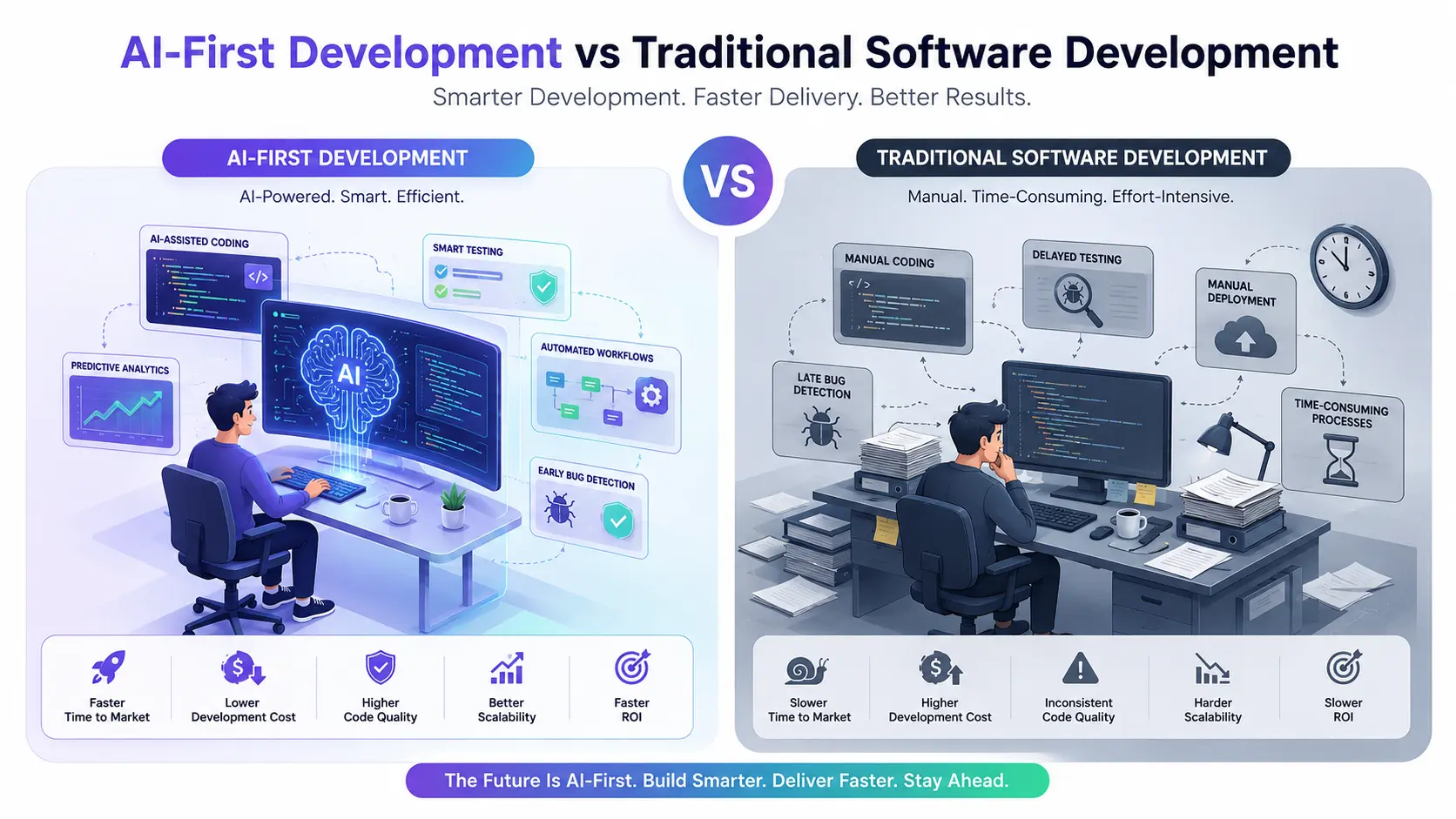
AI-First Development is a modern software development approach where artificial intelligence is integrated into every stage of the software development lifecycle. Instead of using AI as an additional tool after development begins, it becomes part of planning, coding, testing, deployment, and maintenance.
Developers use AI to:
- Generate and improve code
- Create automated tests
- Detect bugs and security vulnerabilities early
- Predict project risks
- Automate repetitive development and DevOps tasks
AI doesn't replace developers—it enhances their productivity by handling repetitive work while developers focus on solving complex problems.
How Traditional Software Development Works
Traditional software development follows a mostly manual workflow. Developers write code line by line, testers manually verify functionality or use limited automation, and bugs are often identified later in the development cycle.
This approach remains reliable and widely adopted, particularly for legacy systems and highly regulated industries. However, it usually requires more development time, higher manual effort, and longer release cycles.
At Olfant, we provide:
- Custom Software Development
- Enterprise Software Development
- Web Application Development
- Mobile App Development
- Cloud Solutions
- UI/UX Design
- Software Maintenance and Support
AI-First Development vs Traditional Software Development
| Factor | AI-First Development | Traditional Software Development |
|---|---|---|
| Development Cost | Lower long-term costs | Higher due to more manual effort |
| Development Speed | Faster with AI-assisted coding and testing | Slower because of manual development |
| Code Quality | AI identifies errors early | Depends heavily on developer expertise |
| Testing | Continuous automated testing | Mostly manual or delayed testing |
| Maintenance | Predictive maintenance | Reactive maintenance |
| Scalability | Designed for scalability from the beginning | Often requires future restructuring |
| Security | Early vulnerability detection | Security reviews usually happen later |
| Innovation | Faster experimentation and prototyping | Slower product innovation |
| Productivity | Higher developer productivity | More repetitive manual work |
| Time to Market | Much shorter | Longer release cycles |
| ROI | Faster business returns | Slower return on investment |
Key Takeaway
AI-First Development doesn't replace software engineers. Instead, it automates repetitive tasks, allowing developers to build better software faster while maintaining high quality.
Benefits of AI-First Development
Faster Product Releases
AI generates boilerplate code, automates testing, and speeds up debugging, allowing businesses to launch products much faster.
Lower Development Costs
By reducing manual work, organizations save both development time and operational costs over the long term.
Higher Software Quality
AI-assisted testing catches bugs before software reaches production, reducing post-launch issues.
Better Project Planning
AI can analyze project requirements and identify risks before development even begins, improving planning accuracy.
Easier Scalability
Applications built using AI-first practices are generally more modular, cloud-ready, and easier to expand as businesses grow.
Industry research from GitHub, Stack Overflow, McKinsey, and Gartner shows that AI adoption among software developers continues to increase rapidly, with significant improvements in productivity and software delivery.
Challenges Businesses Should Know
Although AI-First Development offers many advantages, businesses should consider a few challenges before adopting it.
Learning Curve
Development teams need time to adapt to new AI-powered workflows and tools.
Choosing the Right AI Tools
Not every AI coding assistant or automation platform is suitable for every project.
Human Oversight Is Essential
AI can generate incorrect or inefficient code, making developer review an important part of the process.
Security and Compliance
Organizations handling sensitive data must ensure that AI tools comply with proper security, privacy, and governance standards.
Most of these challenges can be addressed through proper planning and by working with experienced AI development partners.
When Should Companies Choose AI-First Development?
Startups — Startups benefit from AI-first development because it enables them to build Minimum Viable Products (MVPs) quickly with smaller teams and limited budgets.
Small and Medium Businesses (SMEs) — SMEs can modernize existing systems, launch digital products faster, and reduce development costs by leveraging AI-powered automation.
Large Enterprises — Enterprises managing large software projects benefit from AI-first development through improved scalability, standardized code quality, enhanced security, and faster collaboration across teams.
Traditional software development still works well for small projects or organizations that rely heavily on legacy systems. However, for businesses focused on innovation and growth, AI-first development is becoming the preferred approach in 2026.
Conclusion
The shift toward AI-First Development is not about replacing developers. It's about enabling software teams to build applications faster, reduce costs, improve quality, and deliver better business outcomes.
Organizations adopting AI-first practices are already seeing shorter development timelines, quicker product launches, and stronger return on investment compared to businesses relying entirely on traditional development methods.
If your business is exploring AI-powered software development, partnering with an experienced team like Olfant can help you successfully plan, build, and scale AI-driven solutions while minimizing implementation risks.
Get a Free Consultation →